 FAIMS

Frame survey
Every few years enumerators visit every landing site on a lake or stretch of coast and count what is there: the boats, what drives them, the gear on board, the people who fish from them, and the services on shore. FAIMS holds these counts back to 1995 and uses the latest complete round to raise the catch survey.
- landing sites in the latest complete rounds
- 2,250
- fishing craft counted
- 108,492
- fishers counted
- 354,943
- earliest round held
- 2000
A census, not a sample
The frame survey is the one survey in FAIMS that tries to count everything. Teams go site by site around the water body and record each landing site, its facilities and services, and then every fishing craft based there: type, length, propulsion and engine power, crew, main gear, target species, and every gear on board by type, size and number. Foot fishers and rafts are recorded too, as craft of their own.
Because it is a census, its counts describe the fishery directly. The catch survey only ever describes the boats it sampled. That is why the two go together: the frame gives the number of fishing units at each site, and the catch survey’s averages are multiplied by that number to reach a total. A frame that is out of date makes every catch estimate built on it wrong in the same direction.
Rounds follow the regionally harmonised standard operating procedures for frame surveys. Lake Victoria has run them every two years since 2000, by Kenya, Tanzania and Uganda together under LVFO. The Lake Tanganyika regional rounds held in FAIMS are 1995, 2011 and 2024.
What is counted
| Record | What it holds |
|---|---|
| Landing site, once per round | Location, beach management unit and its active members, island or mainland, schools, clinics, banks and mobile money within 2 km, road access, electricity, water, toilets, fish bandas, cold rooms and whether they work, drying racks, smoking kilns, jetties, repair services, fisheries staff visits, fishers lost to capsizing in the past year, factory agents buying fish, boat owners and how many are women, and people who make a living around the catch: processors, traders, net menders, boat builders, transporters, porters |
| Craft, one row each | Type, hull material where it applies, registration and licence, length, main gear, propulsion, horsepower, fuel used per day, crew and female crew, crew by age group, light source and number of lamps, fish finder, navigation aids, connected boats on catamarans, target species, and for ring nets and small seines whether they fish by day, night or both |
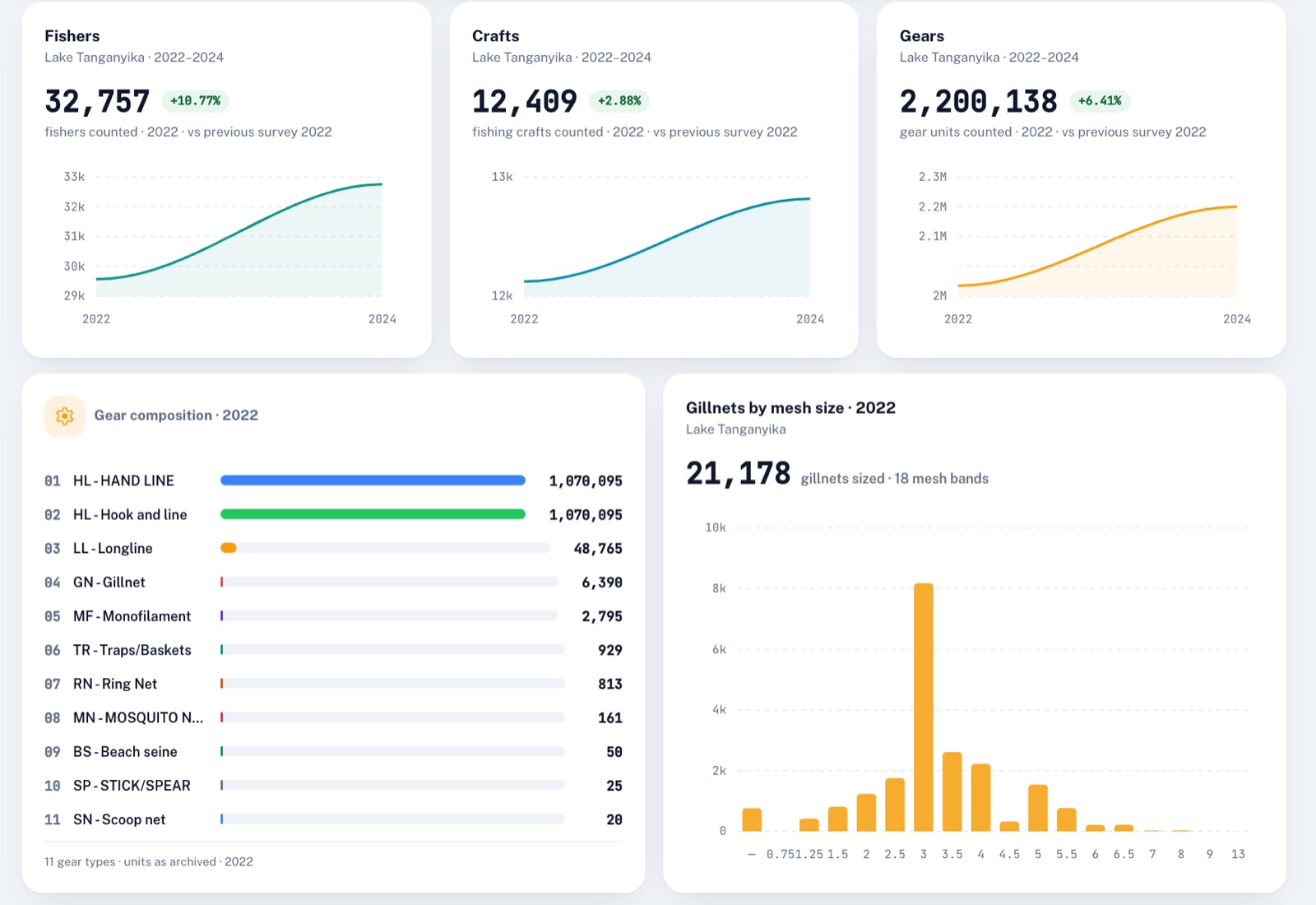
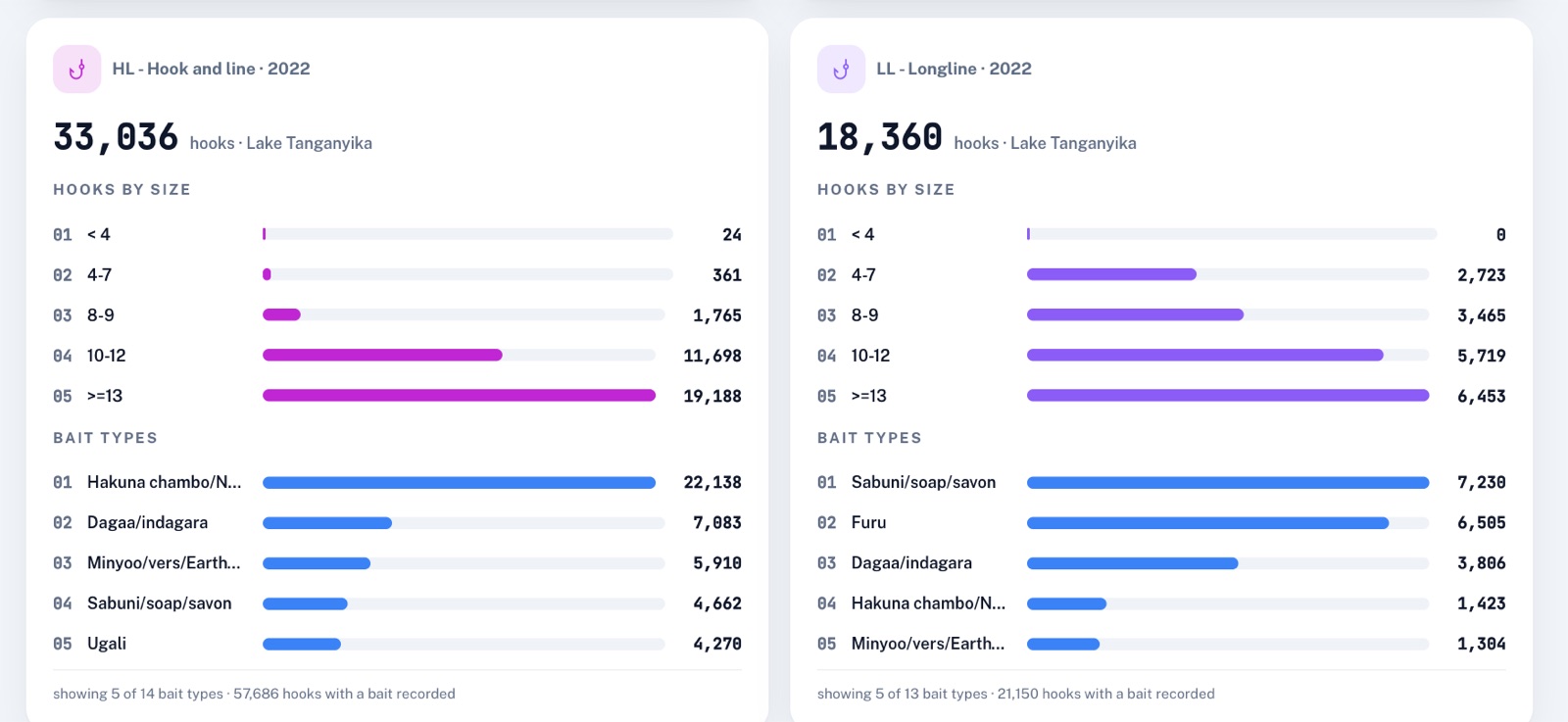
| Gear, one row per type on a craft | Gear type, size, number of gears or hooks, panels, mode of operation and bait. Gillnet mesh is in inches, hooks by number, seine and lift-net mesh in millimetres |
Rounds held only as published summaries, such as Lake Victoria from 2000 to 2016, are stored as archived values per district. Rounds collected in FAIMS keep every craft and gear record, so new tables can be drawn from them later.
Which round counts
A round only counts as complete when it reached at least half as many landing sites as the best round on record for that country and water body. Anything smaller is treated as a pilot. FAIMS shows a pilot as underway but will not compare it with a census: 16 sites surveyed in 2026 say nothing about change since the 579-site round of 2020.
When two complete rounds differ in site coverage by more than half, the comparison is flagged. Ratios such as crew per craft can still be compared. Totals cannot.
How the indicators are defined
| Indicator | Definition |
|---|---|
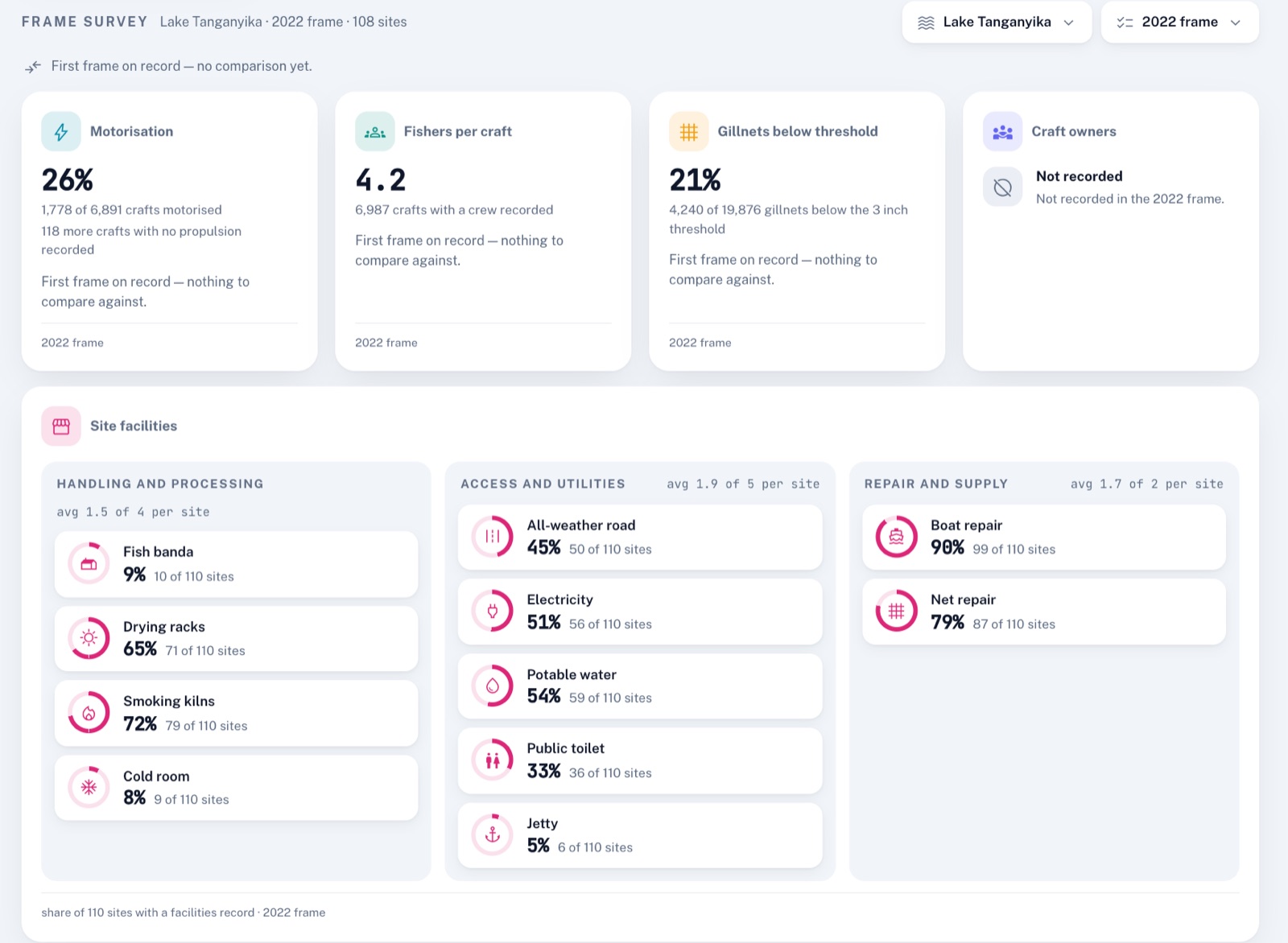
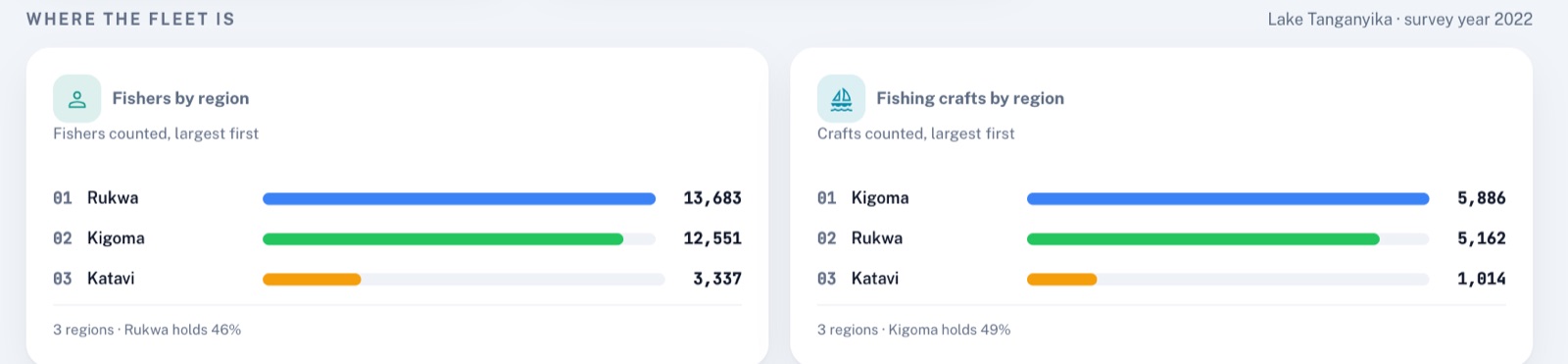
| Fishing craft | One per craft record, foot fishers and rafts included. On Lake Tanganyika a catamaran counts as its connected boats, two unless recorded otherwise, and a boat counts as four planked canoes, the convention of the regional reports there |
| Fishers | Sum of crew over all craft records, foot fishers included |
| Motorised share | Craft with an outboard or inboard engine, divided by craft with any propulsion recorded. Blanks are left out, not counted as paddled |
| Crew per craft | Mean crew over craft that recorded one |
| Registered craft | Registration number containing at least one letter and one digit |
| Length class | Under 5 m, 5 to 11 m, over 11 m |
| Engine power band | Lake Tanganyika: up to 25, 26 to 40, 41 to 65, over 65 HP. Elsewhere: under 9.9, 9.9, 15, over 15 to 45, over 45 HP. Blank horsepower is unknown, not the lowest band |
| Gillnets below the mesh threshold | Nets below 6 inches on Lake Victoria nationally, 7 inches in the regional tables, 3 inches on Lake Tanganyika |
| Facility share | Share of surveyed landing sites with each of eleven facilities. Shown one by one and never added into an index |
| Women among boat owners | Female owners divided by owners, only where owners were recorded |
Two wording rules come from the code itself. Mesh sizes are reported as “below 6 inches”, never as illegal, because whether a given net breaks a given regulation is for the fisheries authority to say. And female crew is not reported at all: it is recorded as zero on 99% of craft, and nobody has yet checked whether that means no women or an empty field.
Feeding the catch survey
Each craft record is turned into a fishing unit code, craft and propulsion and main gear, with the same rules the catch survey uses. The counts per landing site and unit form the table that raising multiplies by.
-
A craft is saved, edited or deleted
Its country, water body and round are marked for a recount. Merging two duplicate landing sites marks them too.
-
The counts are rebuilt overnight
At 02:45 FAIMS recounts units per landing site for every marked slice and replaces the old counts in one step. A recount that comes back empty is refused instead of wiping the slice.
-
Sampling plans follow
Daily targets for the catch survey are regenerated from the new counts, with a second rebuild at 03:15 as a safety net.
The coastal survey on mainland Tanzania still raises with the 2018 frame of 9,534 units at 233 landing sites, held in an older table that FAIMS reads separately.
Data quality
A census of thirty thousand craft collected on phones will contain mistakes. FAIMS runs a set of rules over every frame record when it is saved and again in a full scan every Sunday. Each problem becomes an issue in the same register the catch survey uses, where it can be fixed, accepted as a real exception or marked a false positive, always with a note.
- A part larger than its whole: more female owners than owners, more female crew than crew.
- A total that does not equal men plus women.
- Negative counts, duplicate site records for the same round, gear left behind by a deleted craft.
- Coordinates out of range or at 0, 0.
- Collection dates in the future or more than a year away from the round.
- Craft longer than 50 m or with a crew of more than 100, and gear counts above 10,000.
- A district recorded on the wrong water body.
The last rule weighs each district’s records across the whole platform. When Lake Victoria 2020 holds 133 craft from a coastal district whose 9,424 catch records are all from the Indian Ocean, the craft are probably mis-tagged. FAIMS flags them but will not move them on its own. The only automatic fix is a gender split that does not add up, and it is logged with the old and new values.
Reports and the dashboard
Ten report tables mirror the layout of the LVFO regional frame survey report: a summary of results, a summary across years, fishers and craft, gillnets, other gears, longline and handline hooks, bait, a comparison between rounds, the annex tables, and a landing-site map. Each runs nationally, grouped by region or district, or regionally, with one column per country sharing a lake.
The summary table can be regenerated from the raw records and saved as the archive for that round. The dashboard and the Report Builder read that archive, so a correction reaches them once someone regenerates the summary. Each card on the dashboard explains its own gaps, “not recorded”, “pilot round”, “coverage differs”, instead of showing an unmeasured zero.
Results
Figures are refreshed from FAIMS every night. They are provisional and not for citation. Lake Tanganyika craft follow the regional counting convention, so they are higher than the number of craft records.
References
- LVFO. Regional status report on Lake Victoria biennial frame surveys, 2000 to 2020. Lake Victoria Fisheries Organization, Jinja.
- LVFO. Standard operating procedures for frame surveys on Lake Victoria. Lake Victoria Fisheries Organization, Jinja.
- Stamatopoulos, C. (2002). Sample-based fishery surveys: a technical handbook. FAO Fisheries Technical Paper 425, chapter on frame surveys. Rome, FAO. fao.org